 OnlyLocal
lunch Harajuku
Harajuku lunch: choose the right zone before the cafe
Choose a realistic Harajuku lunch area without spending the afternoon in a trend-driven queue.

Yuki's Short Answer
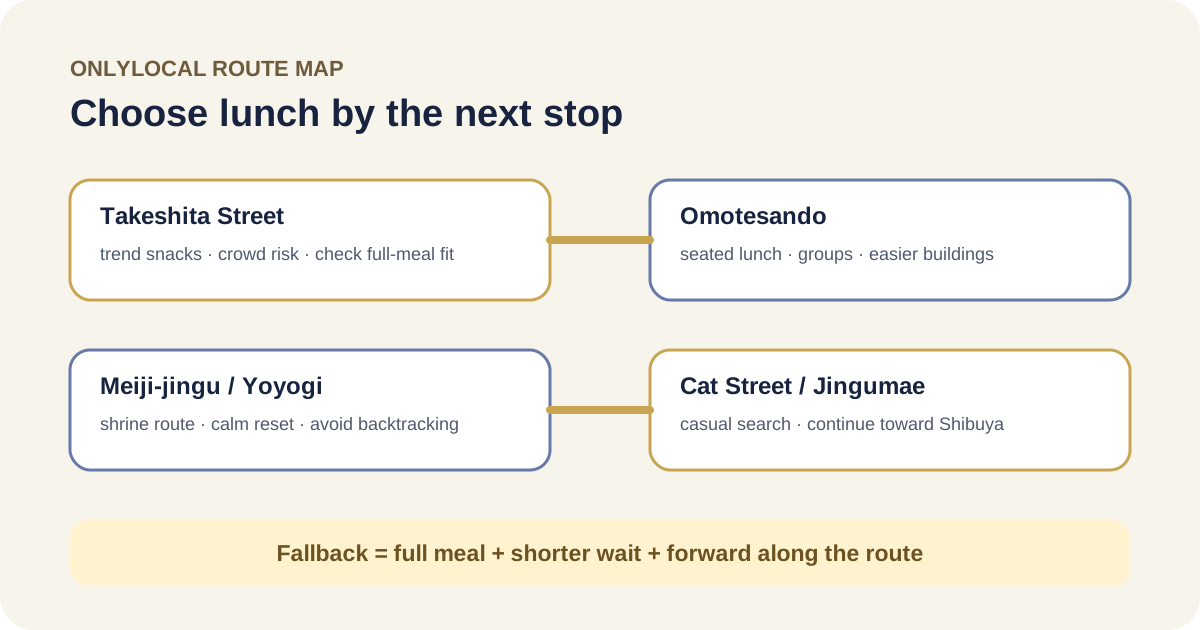
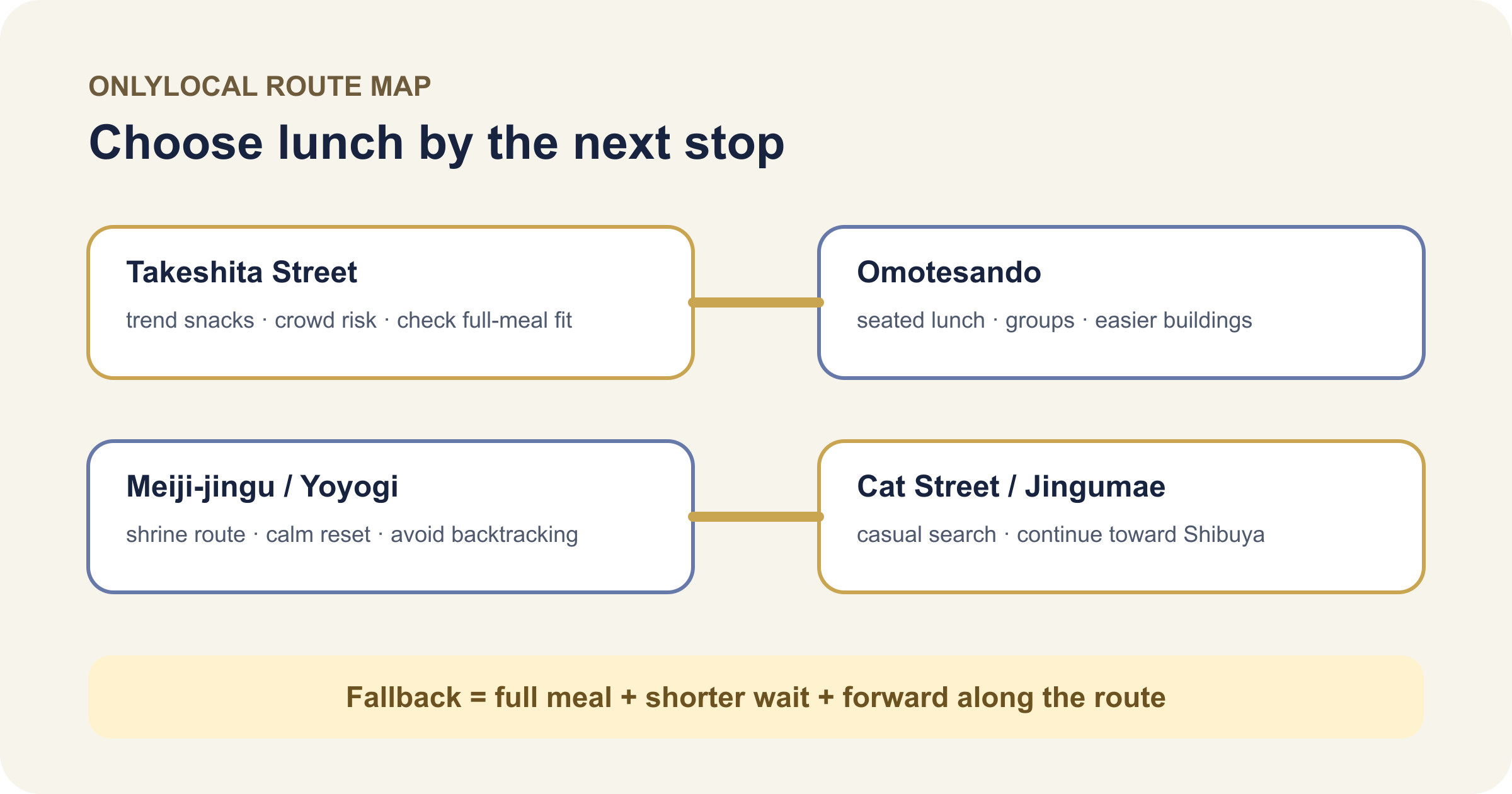
For lunch in Harajuku, choose the zone by the rest of your day. Takeshita Street fits quick, trend-led snacks but can be crowded; Cat Street and Jingumae backstreets give a calmer casual search; Omotesando suits a seated lunch and groups; the Meiji-jingu and Yoyogi side is the easiest reset when central Harajuku is overloaded. Set a queue limit and keep a backup along your next walking route.
Decision Table
| Signal or option | What it means for the trip |
|---|---|
| Takeshita Street | Best for trend-led snacks and a fast first look; weakest choice when the group needs a calm full meal |
| Cat Street / Jingumae | Best for casual cafes and a slower backstreet search between Harajuku and Shibuya |
| Omotesando | Best for seated lunch, mixed-age groups and easier buildings; budget can rise quickly |
| Meiji-jingu / Yoyogi side | Best for resetting after the shrine or escaping the central crowd |
| Door check | Seats, queue, full-meal menu, allergy communication, card/cash and the next stop |
| Fallback rule | Move forward along the day's route instead of returning to the busiest intersection |
The 4-question Harajuku lunch check
A photogenic line should not decide the entire afternoon.
- 01Meal or snack
Does everyone need a full lunch, or is this a trend-food stop?
- 02Route
Meiji-jingu, Shibuya, Omotesando, Aoyama, or the station next?
- 03Friction
Queue, seats, stairs, dietary communication, payment, and weather
- 04Limit
Set a wait cutoff and move forward to the route-aligned backup
Decide whether lunch is the destination or a break
If lunch is a major trip meal, choose a seated format and check the booking path. If it is a break between Meiji-jingu, shopping and Shibuya, prioritize short waits, a complete meal and a location that keeps the route moving.
Treat Takeshita Street as a snack lane, not the only lunch answer
JNTO describes Takeshita Street as the center of Harajuku's youth fashion and street-food culture. That makes it useful for atmosphere and snacks, but a viral line can consume the lunch window without solving hunger, seating or dietary needs.
Use Cat Street and Jingumae when the central crowd is the problem
The Harajuku–Shibuya backstreet axis gives the group more room to compare casual formats while continuing toward the next neighborhood. Save candidates before walking so the search does not become an unstructured detour.
Use Omotesando when the group needs an easier seated meal
Omotesando's broader avenue and larger commercial buildings can be simpler for groups, rain and mixed ages. Check the actual menu and budget before joining a photogenic cafe queue; sweets and drinks do not always equal lunch.
Build the backup around the afternoon route
After Meiji-jingu, keep a Yoyogi-side reset. Heading to Shibuya, move through Cat Street. Continuing to Aoyama, keep an Omotesando option. The best fallback reduces backtracking as well as queue time.
Illustrative traveler scenario
Saturday, 12:40pm · three travelers · Shibuya next
- First choice
- Trend-led Takeshita cafe with a long outdoor queue
- Constraint
- One traveler needs a seated full meal
- Route
- The group plans to walk toward Shibuya
- Decision
- Use a saved Cat Street or Jingumae option instead of returning to Harajuku Station
This example demonstrates route logic and is not a live queue claim.
Decision Checklist
- Full meal or snack
- Next neighborhood
- Personal queue limit
- Seats and group fit
- Allergy or dietary communication
- Card or cash fallback
- Weather and stairs
- Route-aligned backup
Turn this into tonight's plan
OnlyLocal shows local-good picks with reservation friction, queue risk, language comfort, payment notes, and nearby backups.
Ask Yuki to plan tonight
FAQ
What area is best for lunch in Harajuku?
Omotesando is easiest for a seated group lunch; Cat Street and Jingumae suit a casual backstreet search; Takeshita Street is strongest for trend-led snacks and atmosphere.
Should I eat before or after Meiji-jingu?
Choose by the route and hunger level. A quick Yoyogi-side meal can work before the shrine; after the visit, Harajuku, Jingumae or Omotesando can continue the day without backtracking.
Is Takeshita Street good for a full lunch?
It can work, but many visitors are really seeking snacks and visual novelty. Check seating, portion, queue and dietary fit before treating a trend-led stop as the group's main meal.
Do I need a lunch reservation in Harajuku?
Many casual places are walk-in, while popular cafes, larger groups and special restaurants may require or benefit from booking. Follow the venue's official route.
Where should a family eat around Harajuku?
Prefer a larger seated venue and check stairs, stroller space, children's policy, smoke exposure, wait time and menu fit. Omotesando buildings are often a simpler search starting point.
What is a good Harajuku lunch backup?
A backup should be on the route to the next stop, serve a full meal within budget, and have a shorter queue or larger seating format than the first choice.
When is Harajuku least crowded for lunch?
Weekday mornings and early lunch, before about noon, are the calmest times, while weekend afternoons are the peak and Takeshita Street can become shoulder-to-shoulder. If a weekend visit is unavoidable, arriving before 11am or eating after 2pm avoids the worst overlap of shoppers and lunch crowds. Omotesando and the Aoyama side stay noticeably calmer than Takeshita Street at every hour.
How much does lunch cost in Harajuku or Omotesando?
Trendy cafes and brunch spots typically run about 1,500 to 2,500 yen for a lunch set, while casual ramen, udon, or curry nearby can be closer to 1,000 yen. Street snacks like crepes are usually several hundred yen but rarely add up to a real meal. Omotesando skews pricier than Harajuku's backstreets, so pick the side that matches your budget before you start walking.
Is Harajuku a good lunch area with kids?
Yes, in small doses: crepe stands and casual snack shops are fun for children, and there are approachable udon, curry, and family-style restaurants near the station. The main caution is crowd density, since Takeshita Street on a weekend is difficult with a stroller or tired kids. A calmer pattern is a quick snack in Harajuku, then a proper sit-down lunch toward Omotesando or Yoyogi.
Sources and Method
This guide is a traveler decision framework. Official facts are linked below; illustrative scenarios explain the decision process and are not live availability claims.
- Official sourceAll about visiting HarajukuGO TOKYO · Official neighborhood layout, access and visitor contextChecked 2026-08-01
- Official sourceHarajuku & OmotesandoJapan National Tourism Organization · Official area distinctions and shopping-street contextChecked 2026-08-01
- Official sourceHarajukuJapan National Tourism Organization · Official youth-culture, street-food and crowd contextChecked 2026-08-01
Tokyo Food Without Regret
Related Guides
 Asakusa Food After Sensoji: Avoid the Tourist-Trap Lunch Loop
How to choose lunch or dinner after Sensoji in Asakusa, with queue, payment, language, and nearby backup notes.
Shinjuku Izakaya Guide: A Walk-In Plan for Tourists
Choose a Shinjuku izakaya area by group size, queue tolerance, cover charge, smoking, payment, last order, and a same-side backup.
Tokyo Kaiten Conveyor Sushi for Tourists: Which Chain to Choose
How travelers should choose conveyor belt sushi in Tokyo, including English ordering, queue risk, price clarity, and backup options.
Asakusa Food After Sensoji: Avoid the Tourist-Trap Lunch Loop
How to choose lunch or dinner after Sensoji in Asakusa, with queue, payment, language, and nearby backup notes.
Shinjuku Izakaya Guide: A Walk-In Plan for Tourists
Choose a Shinjuku izakaya area by group size, queue tolerance, cover charge, smoking, payment, last order, and a same-side backup.
Tokyo Kaiten Conveyor Sushi for Tourists: Which Chain to Choose
How travelers should choose conveyor belt sushi in Tokyo, including English ordering, queue risk, price clarity, and backup options.