 OnlyLocal
Tokyo restaurants without reservations
Tokyo restaurants without reservations: a walk-in plan
Find a realistic Tokyo dinner tonight without wasting the evening on full or reservation-only restaurants.

Yuki's Short Answer
Yes, you can eat well in Tokyo without a reservation. Choose a walk-in-friendly format such as ramen, curry, soba, casual izakaya, teishoku, tonkatsu or conveyor sushi; arrive before the main 7:00–8:30pm dinner rush; and keep a same-area backup. A famous restaurant is not a walk-in plan until you have checked its queue, ordering language, payment, last order and party-size fit.
Decision Table
| Signal or option | What it means for the trip |
|---|---|
| Ramen, curry, soba, teishoku | Strong walk-in starting point; often fast turnover, but famous branches can still have long queues |
| Conveyor or standing sushi | Usually easier than premium counters; compare the branch queue, ordering system and price format |
| Casual izakaya | Good for one or two people; check seats, otoshi or cover charge, smoking, menu language and payment |
| Department-store dining floors | Useful for groups, rain and choice density; confirm last order because building and restaurant times can differ |
| Premium sushi or course dining | Weak same-day walk-in target; use the official reservation path or choose a comparable casual format |
| Fallback rule | Same station side, same meal mood, similar budget, and no more than a 10–15 minute recovery walk |
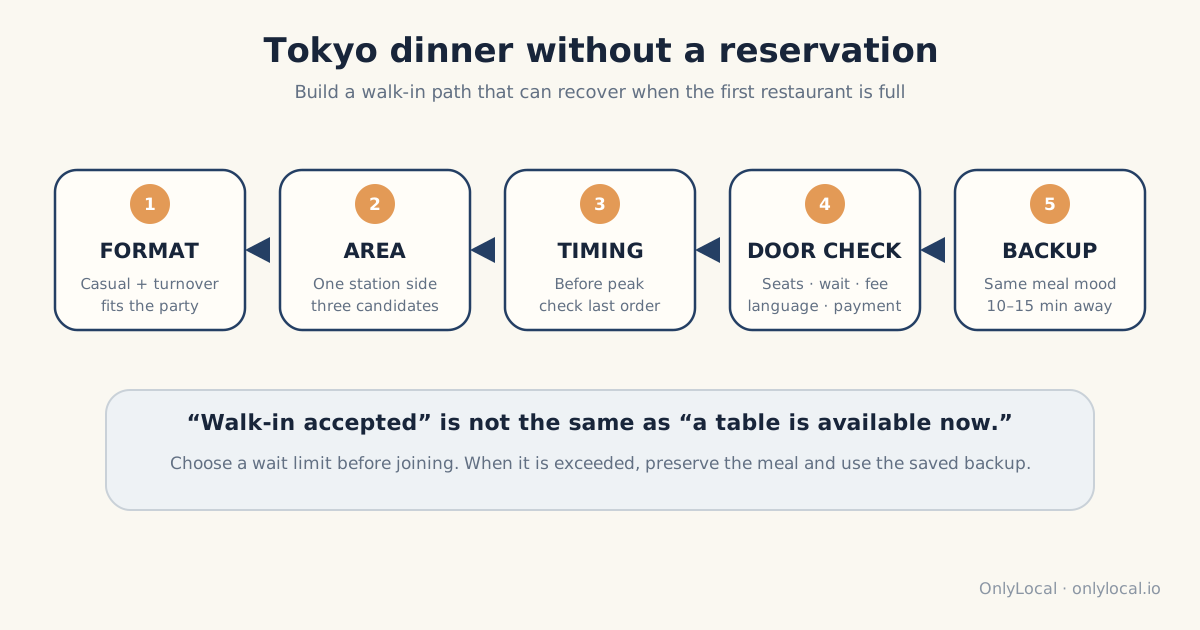
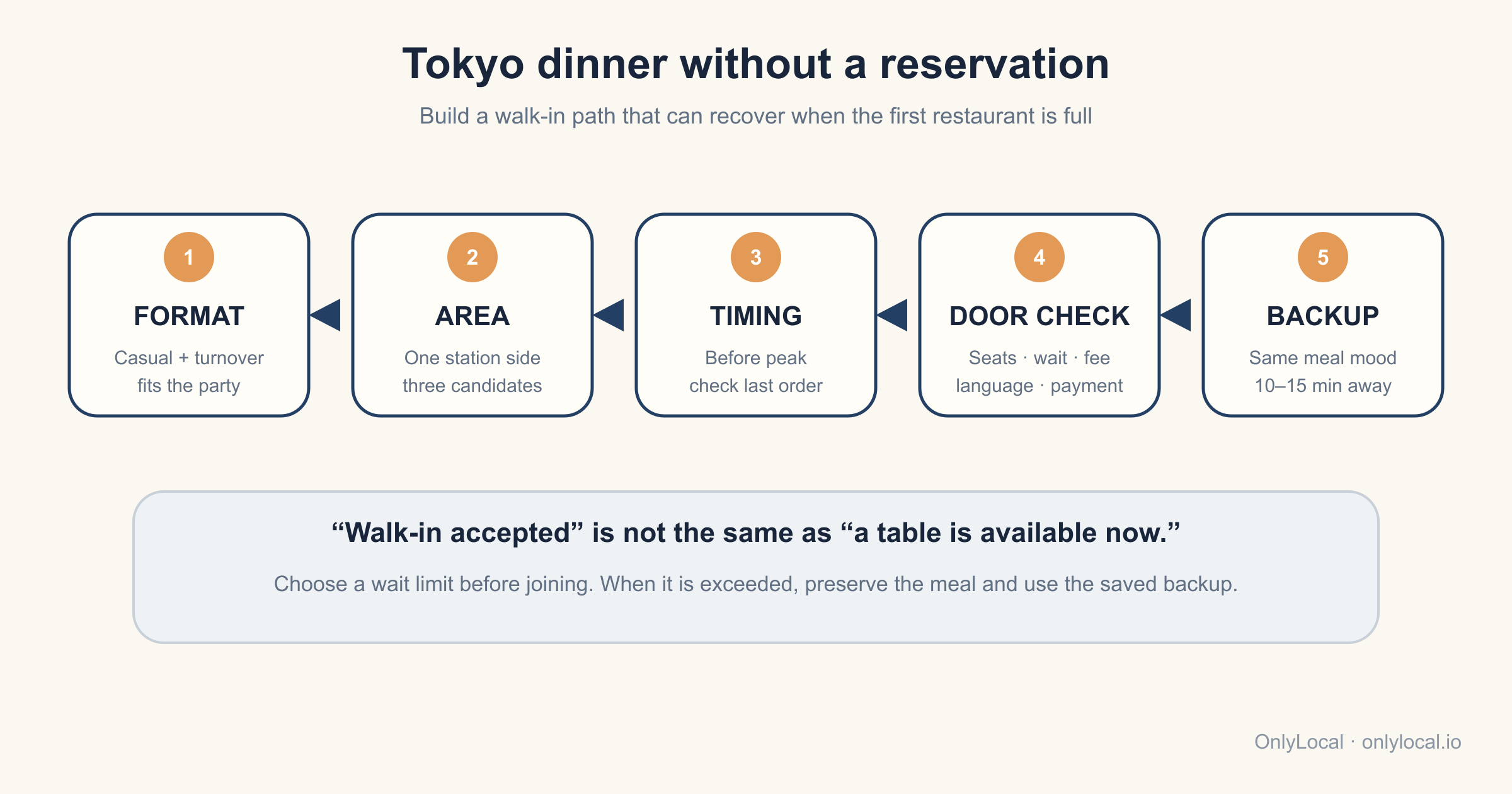
The 6-step Tokyo walk-in plan
Build the recovery path before you walk to the first restaurant.
- 01Format
Choose a casual, high-turnover meal that fits the party
- 02Area
Stay on one station side or in one compact neighborhood
- 03Shortlist
Save three options in the same cuisine and budget lane
- 04Timing
Try before peak and verify today's last order
- 05Door check
Seats, wait, charges, language, payment and group fit
- 06Recover
Move when the wait exceeds the limit you chose
Choose a walk-in format before choosing a famous restaurant
Casual, high-turnover formats give you more realistic same-day options than small premium counters or fixed-course restaurants. Decide the meal format, budget and party size first; use ratings only after the entry conditions fit.
Use timing to avoid the hardest dinner window
An early dinner around 5:30–6:30pm or a later meal after the main rush can improve the odds, but never guarantees a seat. Check the venue's current hours and last order on its official page before traveling.
Search one compact area with several backups
Shinjuku, Shibuya, Ueno, Tokyo Station and other large hubs have many options, but crossing a major station after rejection can waste time. Pick one station side or compact neighborhood and save three candidates there.
Run the door check before joining a queue
Check whether the party fits, how many groups are waiting, whether there is an otoshi or seat charge, how ordering works, whether your payment method is accepted and when last order occurs. A short-looking line at a tiny counter can move slowly.
Use a Japanese phrase without pretending it guarantees entry
You can ask 'Yoyaku nashi de, futari daijobu desu ka?' to ask whether two people without a reservation can enter. The answer still depends on seats, timing and restaurant policy; accept a no politely and move to the saved backup.
Make the backup preserve the meal
A useful backup is not just any open restaurant. Keep the same cuisine or mood, a similar budget and an easier entry format nearby so a full first choice does not restart the evening.
Illustrative traveler scenario
Friday, 6:20pm · two travelers · Shibuya · casual sushi
- First choice
- Small counter with six people waiting
- Constraint
- A ticketed event starts at 8:15pm
- Decision
- Do not join without a wait estimate
- Backup
- Use a saved conveyor-sushi branch on the same side of the station
This example explains the decision process and is not a live queue or availability claim.
Decision Checklist
- Walk-in-friendly meal format
- One compact area
- Three saved candidates
- Personal wait limit
- Otoshi or seat charge
- Ordering and language comfort
- Card or cash fallback
- Last order and next commitment
Turn this into tonight's plan
OnlyLocal shows local-good picks with reservation friction, queue risk, language comfort, payment notes, and nearby backups.
Ask Yuki to plan tonight
FAQ
Can you go to restaurants in Tokyo without a reservation?
Yes. Many casual restaurants accept walk-ins, especially ramen, curry, soba, teishoku, tonkatsu, conveyor sushi and some izakaya. Availability is never guaranteed, so arrive away from peak time and save a backup.
What Tokyo restaurants usually need reservations?
Premium sushi counters, omakase, kaiseki, small destination restaurants, special-occasion dining and fixed-course venues are more likely to require or strongly benefit from advance booking.
What time is easiest for a Tokyo walk-in dinner?
Before the main 7:00–8:30pm rush is often easier. Around 5:30–6:30pm can improve your odds, while late dining depends on the venue's last order.
Is a restaurant near me with no reservation requirement guaranteed to have a table?
No. Walk-in means the restaurant may accept guests without advance booking, not that a seat is available now. Party size, current queue and seat turnover still matter.
What should I say when I do not have a reservation?
You can say 'Yoyaku nashi de daijobu desu ka?' meaning 'Is it okay without a reservation?' Add the party size, such as 'futari' for two people.
What is the best backup when a Tokyo restaurant is full?
Choose the same cuisine and budget on the same side of the station, ideally within a 10–15 minute walk and with a larger or faster-turnover format.
How much does a walk-in dinner in Tokyo usually cost?
A casual walk-in dinner in Tokyo often costs around 1,000 to 2,000 yen per person for ramen, curry, soba, or a set meal, and roughly 3,000 to 5,000 yen at an izakaya once drinks are included. Ticket-machine shops and lunch-style set menus are the cheapest reliable options. Prices are usually posted outside or on the machine, so you can check before committing.
Do Tokyo walk-in restaurants have English menus?
Many casual walk-in places have some English support, such as picture menus, ticket machines with photos, or plastic food displays in the window, but small independent restaurants vary a lot. Chains and station-building restaurants are the most consistently easy for non-Japanese speakers. If there is no English at all, pointing at photos or the display case works fine in most casual formats.
Is it harder to walk in with a group of four or more in Tokyo?
Yes, groups of four or more are noticeably harder to seat without a reservation because many casual restaurants are counter-based with seats for one or two. Izakaya, chain restaurants, and department-store dining floors handle groups best. If your group is large and flexible, splitting into pairs at a counter spot can turn a long wait into almost none.
Sources and Method
This guide is a traveler decision framework. Official facts are linked below; illustrative scenarios explain the decision process and are not live availability claims.
- Official sourceMaking ReservationsJapan National Tourism Organization · Official guidance on reservations, punctuality and restaurant responsibilityChecked 2026-08-12
- Official sourceDinner at a Japanese TavernJapan National Tourism Organization · Izakaya format, ordering, otoshi and traveler etiquetteChecked 2026-08-12
- Official sourceJapanese Customs and EtiquetteJapan National Tourism Organization · Official visitor etiquette and communication contextChecked 2026-08-12
Tokyo Food Without Regret
Related Guides
 Ginza Dinner Without Reservation: A Realistic Tourist Plan
A practical traveler guide to Ginza dinner without reservation, with queue, reservation, language, payment, timing, and backup-plan notes.
Tokyo Restaurant Rejected Your Overseas Reservation? What to Do
What foreign travelers should do when a Tokyo restaurant will not accept overseas reservations, including concierge-only venues, card holds, and backup paths.
How to Make Restaurant Reservations in Japan as a Foreigner (2026)
Use a Japan restaurant's official booking path, confirm fees and cancellation terms, get help with phone-only venues, and keep a realistic backup.
Ginza Dinner Without Reservation: A Realistic Tourist Plan
A practical traveler guide to Ginza dinner without reservation, with queue, reservation, language, payment, timing, and backup-plan notes.
Tokyo Restaurant Rejected Your Overseas Reservation? What to Do
What foreign travelers should do when a Tokyo restaurant will not accept overseas reservations, including concierge-only venues, card holds, and backup paths.
How to Make Restaurant Reservations in Japan as a Foreigner (2026)
Use a Japan restaurant's official booking path, confirm fees and cancellation terms, get help with phone-only venues, and keep a realistic backup.